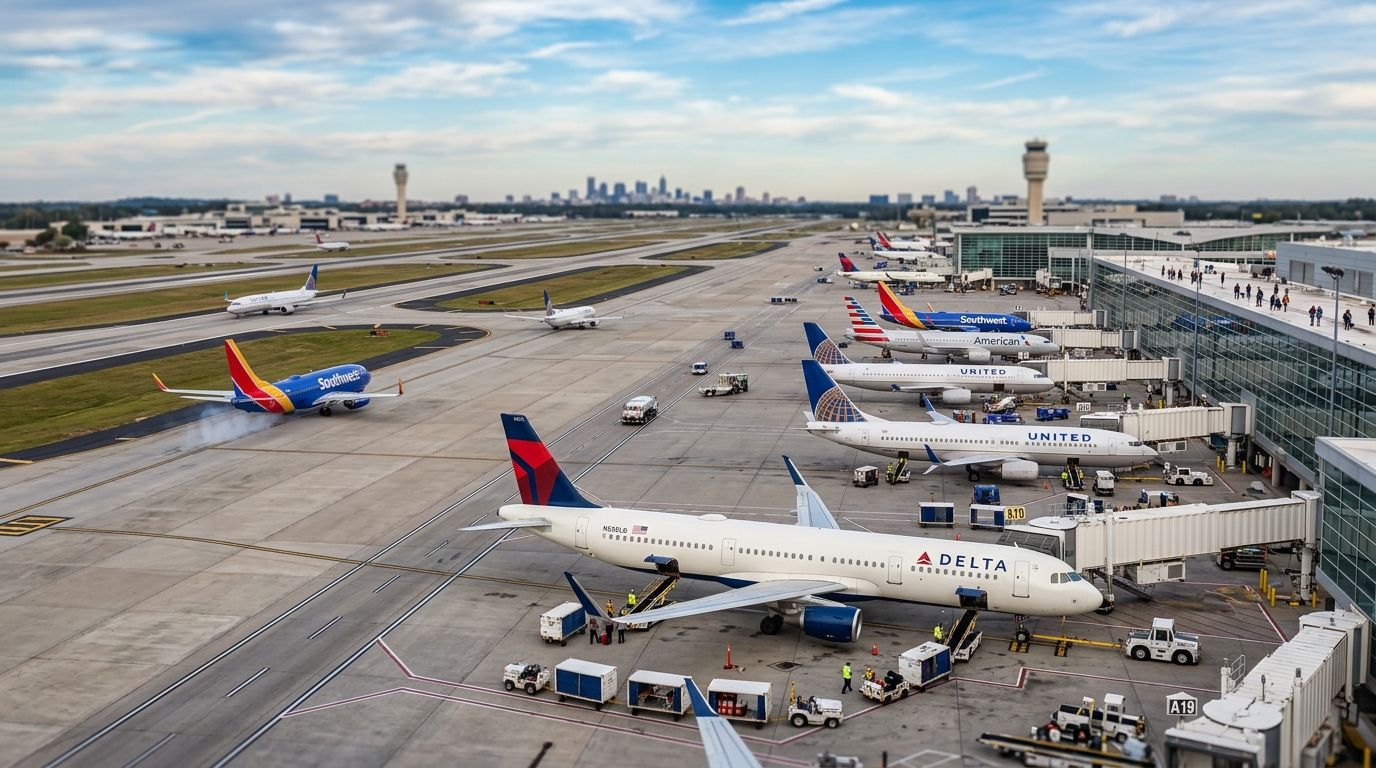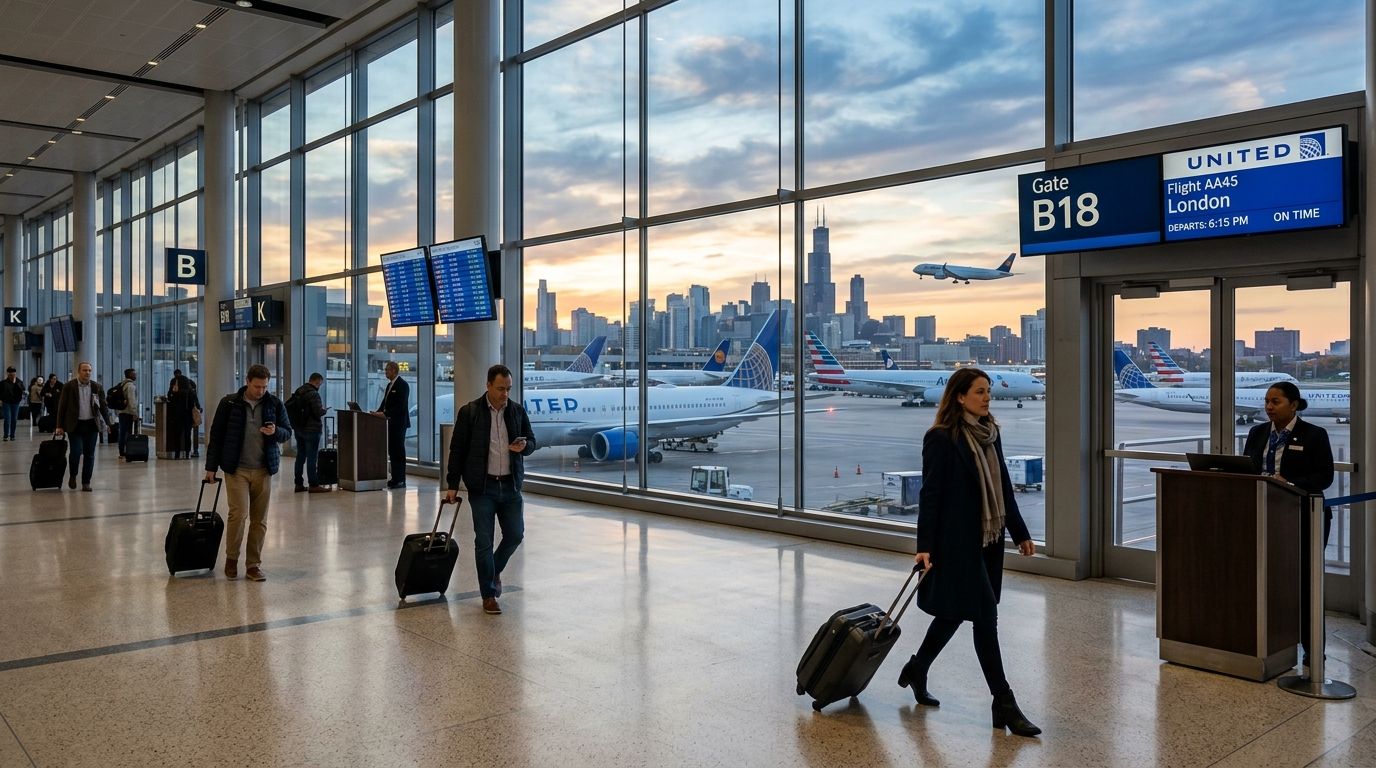
Chicago O'Hare (ORD) runs two major hub operations at once — American Airlines and United Airlines both schedule connection banks through it — which means your on-time odds depend more on which carrier you fly than on the airport itself. This guide ranks the best airlines from Chicago O'Hare for on-time flights in 2026 by structural reliability, not marketing claims.
- Delta Air Lines is the best overall pick among the best airlines from Chicago O'Hare for on-time flights in 2026 because it runs a lighter, non-hub schedule at ORD.
- American Airlines and United Airlines operate O'Hare's two largest hubs, which exposes their flights to more cascade delays during peak connection banks.
- Southwest Airlines and Alaska Airlines post fewer point-to-point routes through ORD, reducing their exposure to hub congestion.
- Spirit Airlines and Frontier Airlines carry the highest delay risk of any O'Hare carrier due to tighter aircraft turnaround schedules.
- Checking a specific flight's delay risk before booking beats relying on an airline's overall reputation alone.
Why this matters
An airline's system-wide on-time rate tells you almost nothing about your specific ORD departure at 5:40 PM on a Thursday. Hub carriers at O'Hare stack dozens of arrivals and departures into tight banks so passengers can connect — one late inbound aircraft ripples through six or seven downstream flights. Non-hub carriers flying point-to-point out of ORD don't carry that same cascade risk.
That structural difference is why a delay risk check on a specific flight matters more at O'Hare than at a smaller, single-carrier airport. The airline matters, but so does the hour, the aircraft's prior leg, and how congested O'Hare's airspace is that day.
What makes the best airline for on-time flights from O'Hare
- Hub exposure — hub carriers (American, United) run connection banks that multiply delay risk when one inbound flight runs late.
- Aircraft turnaround time — airlines that schedule tighter turns between flights have less buffer to absorb a late arrival.
- Route type — point-to-point flights avoid the connection-bank cascade that hub flights inherit.
- Time-of-day scheduling — morning departures avoid the delay buildup that accumulates through the day at congested hubs.
- Fleet and gate assignment — carriers with dedicated terminals face less taxi and gate-hold time than those sharing gates.
- Historical reliability reputation — carriers with a track record of disciplined scheduling tend to hold that pattern year over year.
Best airlines from O'Hare at a glance
| Airline | Best for | Standout trait | Key limitation |
|---|---|---|---|
| Delta Air Lines | Best overall on-time reliability | Non-hub, lighter ORD schedule | Fewer nonstop options than American or United |
| Southwest Airlines | Best budget point-to-point flying | Simple point-to-point network avoids hub cascades | No assigned seating, fewer international connections |
| Alaska Airlines | Best for West Coast routes | Smaller, disciplined ORD schedule | Limited route map from ORD |
| American Airlines | Best domestic network coverage | Widest number of nonstop destinations from ORD | Hub congestion raises cascade delay risk |
| United Airlines | Best for international one-stop connections | Dense international connection bank | Same hub-cascade exposure as American |
| Spirit Airlines & Frontier Airlines | Best avoided when arrival time matters | Lowest fares among ORD carriers | Tightest turnaround schedules, least delay buffer |
1. Delta Air Lines: best O'Hare airline for on-time reliability
Delta Air Lines flies ORD as a focus city, not a hub, which means it schedules fewer connecting itineraries through the airport and carries less cascade-delay exposure than American or United. It's a mainline domestic carrier with a smaller ORD footprint but a track record for disciplined scheduling across its network.
Delta Air Lines pros:
- Non-hub status at ORD limits cascade delay exposure
- Reputation for consistent scheduling discipline
- Reliable connections through Delta's Atlanta and Minneapolis hubs for onward travel
Delta Air Lines cons:
- Fewer nonstop destinations from ORD than American or United
- Premium fares on popular routes
- Smaller schedule means fewer backup flights if your original departure is canceled
Best for: travelers who want the lowest structural delay risk on a domestic ORD route. Verdict: Buy.
2. Southwest Airlines: best budget point-to-point option from O'Hare
Southwest Airlines runs a point-to-point network rather than a connection-bank hub model, which keeps individual flight delays from spreading across a bank of downstream departures the way they do at American or United. It operates a significant O'Hare schedule without the same hub-cascade structure.
Southwest Airlines pros:
- Point-to-point model avoids hub-cascade delays
- Frequent departures on popular domestic routes
- Historically strong reputation for on-time performance among budget carriers
Southwest Airlines cons:
- No assigned seating
- Limited international connections from ORD
- Fewer premium cabin options
Best for: budget-conscious travelers flying direct domestic routes. Verdict: Buy.
3. Alaska Airlines: best for West Coast connections through O'Hare
Alaska Airlines flies a smaller schedule out of ORD focused on West Coast routes. Its limited footprint at the airport means fewer flights are exposed to O'Hare's peak-hour congestion, and Alaska has built a reputation for reliability on the routes it does fly.
Alaska Airlines pros:
- Smaller, tightly managed ORD schedule
- Strong reliability reputation on West Coast routes
- Less exposure to O'Hare peak-hour congestion given lower flight volume
Alaska Airlines cons:
- Limited route map from ORD compared to hub carriers
- Fewer daily frequencies if you miss a flight
- Not a practical option for East Coast or international travel from ORD
Best for: travelers heading to Seattle, Portland, or other West Coast cities. Verdict: Buy.
4. American Airlines: best for domestic network coverage from O'Hare
American Airlines operates one of its largest hubs at O'Hare, which gives it the widest number of nonstop domestic destinations of any carrier at the airport. That network breadth comes with a tradeoff: hub operations run tight connection banks, and a late inbound aircraft during a peak bank can push delays across multiple downstream flights.
American Airlines pros:
- Widest domestic nonstop network from ORD
- More rebooking options within its own schedule if a flight is delayed or canceled
- Frequent departures throughout the day on major routes
American Airlines cons:
- Hub congestion raises cascade delay risk during peak banks
- Aircraft often flies multiple ORD legs in a day, so morning delays compound by evening
- Gate and taxi congestion during peak hours
Best for: travelers who need the most nonstop route options from ORD and can build in a buffer. Verdict: Hold — check your specific flight's delay risk before booking a tight connection.
5. United Airlines: best for international one-stop connections through O'Hare
United Airlines runs O'Hare as a major international gateway hub, with dense connection banks linking domestic feeder flights to long-haul departures. That density is what makes it useful for one-stop international routing, and it's also what exposes it to the same hub-cascade risk as American.
United Airlines pros:
- Strong international one-stop connections through ORD
- Wide domestic feeder network into the hub
- Frequent long-haul departures
United Airlines cons:
- Hub-cascade exposure comparable to American Airlines
- International connections leave little schedule buffer if the domestic leg runs late
- Peak-hour gate congestion at Terminal 1
Best for: travelers connecting through ORD onto an international long-haul flight. Verdict: Hold — check delay risk on the domestic feeder leg specifically.
6. Spirit Airlines and Frontier Airlines: skip when arrival time matters
Spirit Airlines and Frontier Airlines both run ultra-low-cost operating models built around tight aircraft turnaround schedules and high daily utilization per plane. That model works on fare price but leaves almost no schedule buffer, so a single delayed inbound aircraft has an outsized effect on the rest of that plane's day.
Spirit and Frontier pros:
- Lowest fares among O'Hare carriers
- Point-to-point routing on many domestic routes
Spirit and Frontier cons:
- Tightest turnaround schedules of any O'Hare carrier
- Least buffer to absorb a late inbound flight
- Fewer rebooking options if a flight is canceled
Best for: travelers prioritizing fare price over arrival certainty, with no downstream connection or event riding on the arrival time. Verdict: Skip if your arrival time actually matters.
Check your O'Hare flight's delay risk
See the delay probability for your exact flight, airline, and departure time before you book.
How this ranking works
Each airline above is ranked against the six criteria listed earlier: hub exposure, aircraft turnaround time, route type, time-of-day scheduling, fleet and gate assignment, and historical reliability reputation. Non-hub and point-to-point carriers rank higher because they structurally avoid the connection-bank cascade that defines O'Hare's two largest hub operations. For a broader comparison of tools that model this kind of delay risk across airlines, see how delay prediction apps compare in 2026.
Which airline should you choose from O'Hare?
If you need one answer: Delta Air Lines is the safest default for on-time reliability from Chicago O'Hare in 2026, given its non-hub status and lighter schedule at the airport. Southwest Airlines is the right call if you're booking budget and flying point-to-point. American Airlines and United Airlines are still the right pick when you need their route network, but check the specific flight's delay risk before locking in a tight connection — the hub structure means the airline's overall reputation matters less than that day's schedule pressure. Spirit and Frontier are the ones to reconsider anytime arrival time is non-negotiable.
FAQ
What is the best airline for on-time flights from Chicago O'Hare in 2026?
Delta Air Lines ranks as the most reliable option in 2026 because it runs ORD as a focus city, not a hub, avoiding the connection-bank cascade delays that affect American Airlines and United Airlines.
Is American Airlines or United Airlines more reliable at O'Hare?
Both run comparable hub operations at ORD with similar cascade delay exposure during peak connection banks. Neither has a structural reliability edge over the other at this airport.
Why are Spirit and Frontier more delayed at O'Hare than other airlines?
Spirit Airlines and Frontier Airlines schedule tighter aircraft turnaround times to maximize daily utilization, which leaves less buffer to absorb a late inbound flight before the next departure.
Does Southwest Airlines have hub delays at O'Hare?
Southwest Airlines runs a point-to-point network rather than a connection-bank hub model at ORD, so individual flight delays are less likely to cascade across multiple downstream departures.
Are morning flights from O'Hare less delayed than evening flights?
Yes. Delays build through the day at congested hubs like O'Hare as late aircraft compound across multiple legs, so morning departures generally carry lower delay risk than evening ones.
How much does DelayGuard cost to check flight delay risk?
DelayGuard offers a free tier and a premium tier at $4.99 per month or $39 per year, covering delay risk predictions across 65+ US airports.
Is Alaska Airlines a good option from O'Hare?
Alaska Airlines runs a smaller ORD schedule focused on West Coast routes, which limits its exposure to O'Hare's peak-hour congestion and gives it a strong reliability reputation on those routes.
Do connecting flights through O'Hare have higher delay risk than nonstops?
Yes. Connecting itineraries through hub carriers like American and United inherit the delay risk of the inbound feeder flight in addition to the outbound leg, compounding the odds of a late arrival.
One last thing
The airline you pick matters less than the hour you fly it. A hub carrier's 7 AM ORD departure and its 7 PM departure on the same route can carry meaningfully different delay odds, because the evening flight has absorbed a full day of upstream schedule pressure by the time it pushes back. Pick the airline for the route and network you need, then check the specific flight and time before you book.