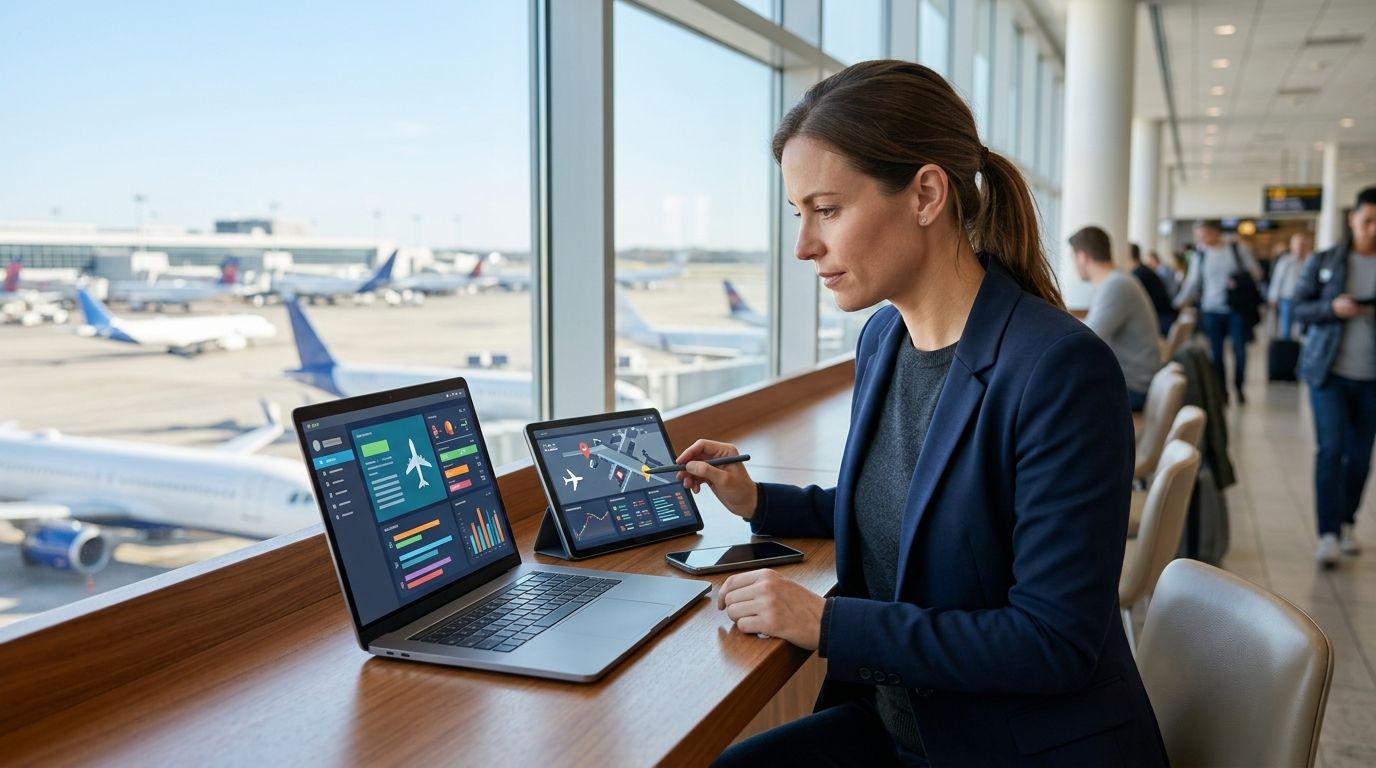
DelayGuard predicts delay risk before you fly. FlightAware tracks flights that are already scheduled or in the air. Choose DelayGuard if you want a risk percentage before you book or head to the airport; choose FlightAware if you need live tracking, gate data, and a global historical archive for a flight already on the board.
- DelayGuard vs FlightAware comes down to prediction vs tracking — DelayGuard scores delay risk before departure, FlightAware tracks flights in real time.
- DelayGuard covers 65+ US airports and major domestic carriers with a free tier plus a paid premium tier.
- FlightAware wins on global coverage, historical depth, and live ADS-B tracking for flights already in the system.
- Use DelayGuard when deciding whether to book, change, or leave early. Use FlightAware once the flight is confirmed and you need live status.
Why this matters
Most travelers open a flight tracker after a delay is already happening. That's too late to do anything but wait. The real decision — book this flight or a different one, leave for the airport now or in an hour, buy the earlier connection — happens before departure, and that's a different data problem than tracking a plane that's already pushed back from the gate.
DelayGuard was built for that earlier window: an AI model trained on historical US domestic flight data scores your specific route, airline, and time of day for delay risk before you commit. FlightAware was built for the window after that — once a flight number exists, it tracks the aircraft, the gate, and the taxi and takeoff status in real time. Neither tool replaces the other. The mistake is expecting one to do the other's job in 2026.
At a glance
| Dimension | DelayGuard | FlightAware |
|---|---|---|
| Best for | Checking delay risk before booking or before you leave for the airport | Tracking a specific flight's live status once it's scheduled or airborne |
| Core function | AI-generated delay risk score by route, airline, and time | Real-time flight tracking via ADS-B data |
| Coverage | 65+ US airports, major domestic airlines | Thousands of airports worldwide, including general aviation |
| Prediction vs. tracking | Predictive — scores risk before the flight happens | Reactive — reports status once the flight is in the system |
| Historical data | Airline and airport delay-pattern history | Flight-by-flight historical archive, global |
| Pricing model | Free tier, paid premium tier, credit packs | Free tier, paid subscription and API/enterprise plans |
| Standout feature | Pre-flight delay risk percentage | Live map with real-time aircraft position |
| Best used | Before you book or before you leave home | After the flight is scheduled and you or someone else is en route |
DelayGuard predicts delay risk before you book (FlightAware doesn't do this)
This is the core split. DelayGuard's model runs on historical US domestic flight patterns and returns a risk percentage tied to a specific route, airline, and departure window — before a single wheel has left the ground. FlightAware has no equivalent feature for a flight that hasn't happened yet; it needs a scheduled or active flight number to return anything useful.
If you're comparing a 7am departure against a 6pm departure on the same route, DelayGuard is the tool that tells you the 6pm flight carries meaningfully higher delay risk before you pay for either ticket. FlightAware can't answer that question until both flights exist on a schedule and start accumulating live data.
Verdict: DelayGuard wins on pre-flight prediction. This isn't close — it's the entire reason the product exists.
FlightAware wins on real-time tracking (by a lot)
Once a flight number is active, FlightAware's ADS-B-based tracking shows aircraft position, altitude, gate assignment, and taxi status updated continuously. This is the tool for watching a flight already airborne, or for someone picking up a passenger who wants gate-level accuracy in 2026.
DelayGuard isn't built for this job and doesn't try to be. It's a pre-flight risk tool, not a live radar. If your flight already pushed back from the gate, FlightAware is the better open tab.
Verdict: FlightAware wins on live tracking. No contest.
FlightAware has broader global coverage
FlightAware tracks flights worldwide, including cargo and general aviation traffic well outside the US domestic network. DelayGuard's model is deliberately scoped to 65+ US airports and major domestic airlines — depth over breadth.
If you're tracking an international flight or a private aircraft, FlightAware is the only one of the two with data to show you. DelayGuard doesn't claim coverage it doesn't have.
Verdict: FlightAware wins on geographic reach.
DelayGuard is the sharper tool for a specific US domestic decision
Within its scope — a US domestic route, a named airline, a specific time of day — DelayGuard's model is built to answer one question precisely: what's the delay risk for this exact combination. That narrower focus is a tradeoff, not a limitation nobody chose. A best flight delay prediction apps compared look at the category shows most tools in this space either track live flights or aggregate generic on-time percentages by airline — few isolate risk by route and time window the way DelayGuard does.
Verdict: DelayGuard wins on precision for US domestic pre-flight decisions.
Both handle basic flight lookup well
If all you want is to confirm a flight number, departure time, and gate for a flight already scheduled, both tools return that information cleanly. Neither has a meaningful edge here — this is table stakes for either product in 2026.
Verdict: tie.
FlightAware has the deeper historical archive
FlightAware has tracked and logged individual flights for years across a global network, which gives it a denser historical archive for any single flight number or tail number. DelayGuard's historical data is narrower by design — it's built to feed a predictive model for US domestic routes, not to serve as a general-purpose flight history lookup.
If you need to pull up exactly how a specific flight performed on a specific date last year, FlightAware's archive is deeper.
Verdict: FlightAware wins on historical depth.
Pricing: predictability vs. flexibility
DelayGuard runs a free tier alongside a paid premium tier and credit packs, so casual users can check risk scores without committing, while frequent flyers can pay for ongoing access. FlightAware also runs a free consumer tier with paid subscription and API-level plans aimed at businesses and developers who need programmatic tracking access.
The tradeoff is straightforward: DelayGuard's model is built around per-check or subscription access to a risk score, while FlightAware's paid tiers scale toward API and enterprise use cases built on live tracking data. Neither publishes pricing that belongs in a comparison table that goes stale — check the current plans directly on each site before deciding.
Check your flight's delay risk before you book
See a route-specific risk score for 65+ US airports.
Final verdict
Choose DelayGuard if: you're deciding between flight options, picking a departure time, or trying to gauge delay risk before you commit money to a US domestic ticket in 2026. A business traveler choosing between a 6am and a 2pm flight on the same route is the textbook DelayGuard use case.
Choose FlightAware if: you already have a booked flight and need live tracking, gate updates, or historical data on a specific flight number — especially outside the US or for general aviation. Someone picking up a connecting family member at the airport is the textbook FlightAware use case.
Many travelers in 2026 end up using both: DelayGuard to pick the flight, FlightAware to track it once it's booked. If you're weighing other options in this category, a look at FlightAware alternatives covers tools built for similar tracking-first use cases.
Scorecard
| Dimension | Winner |
|---|---|
| Pre-flight prediction | DelayGuard |
| Real-time tracking | FlightAware |
| Global coverage | FlightAware |
| US domestic precision | DelayGuard |
| Basic flight lookup | Tie |
| Historical archive | FlightAware |
FAQ
Is DelayGuard better than FlightAware?
DelayGuard is better for predicting delay risk before you book or fly. FlightAware is better for tracking a flight that's already scheduled or airborne. They solve different problems, not the same one.
Does FlightAware predict flight delays before they happen?
FlightAware focuses on real-time tracking and historical data for flights already in the system rather than generating a pre-flight risk score. DelayGuard is built specifically for that predictive step.
What airports does DelayGuard cover?
DelayGuard covers 65+ US airports and major domestic airlines as of 2026. It doesn't cover international or general aviation traffic the way FlightAware does.
Can I use DelayGuard and FlightAware together?
Yes. Many travelers use DelayGuard to choose a lower-risk flight before booking, then switch to FlightAware for live tracking once the flight is confirmed.
Which app is better for tracking a connecting flight?
FlightAware's real-time tracking is built for monitoring a flight already in progress, including connections. DelayGuard is better used beforehand to assess whether a tight connection carries elevated delay risk.
Does DelayGuard have a free version?
DelayGuard offers a free tier alongside a paid premium tier and credit packs. FlightAware also offers a free consumer tier with paid options for deeper access.
Is FlightAware only for US flights?
No. FlightAware tracks flights globally, including international and general aviation traffic, which is broader coverage than DelayGuard's US domestic focus.
One last thing
The biggest mistake travelers make in 2026 isn't picking the wrong tool — it's opening a tracker after boarding instead of a predictor before booking. By the time a flight shows a delay on FlightAware, the decision window has already closed. Run the risk check before you buy the ticket, not after you're sitting at the gate.